The last few days have seen a lot of media coverage and talk about the World Bank’s “Ease of Doing Business Rankings”. So yes, India has been ranked 100 out of 190 countries and that’s a gigantic leap of 30 places up from last year but what does this mean? Why is it important for a common man to know? How are these ranking derived? If you’ve been wondering this and more, then read on as the GK Nugget tries to simplify the Ease of Doing Business Rankings. What are the Ease of Doing Business rankings?Every year the World Bank ranks 190 countries of the world on the basis of various parameters. These rankings are based on 10 indicators such as getting credit, paying taxes, enforcing contracts, resolving insolvency, etc.Higher the ranking; better is the environment to start and run a business in that country. The rankings are calculated for the period June to May of the previous year (i.e. June 2016 to May 2017 for the Doing Business Report 2018). Usually 1 city in each country is surveyed, but for large countries 2 cities are surveyed (Mumbai & Delhi were surveyed for India).
Why are the rankings important? These rankings indicate how easy it is to run a business in that country, which in turn boosts employment and growth. It also attracts foreign investment. Most importantly, an improvement in the rankings indicates that the country is taking steps to implement reforms and is bringing about positive changes.
So how has India fared? India was ranked 142 in 2015, 130 in 2016, 130 in 2017 and now it has been ranked 100 in 2018. India making a jump of 30 rankings is a big deal because it is a feat which is rarely achieved and also it is very difficult for a large economy to make such a drastic advance. The report acknowledges India as a top improver with the highest jump in rank of any country. Which areas showed improvement? Out of the 10 indicators that are taken into account to get the Ease of Doing Business rankings, India has improved its rankings in 6 indicators compared to last year. Construction permits – 181 (up from 185) Getting credit – 29 (up from 44) Protecting minority investors – 4 (up from 13) Paying taxes – 119 (up from 172) Enforcing contracts – 164 (up from 172) Resolving insolvency – 103 (up from 136) In which indicators did our performance deteriorate?Starting a business – 156 (down from 155) Getting electricity – 29 (down from 26) Registering property – 154 (down from 138) Trading across borders- 146 (down from 143) What led to this improvement in the rankings?Some of the reforms which were implemented by the government in the past year have helped boost the ranking. E. g.: Insolvency & Bankruptcy Code coming into force has made it easier to resolve insolvencies, rules & procedures cut for building permits, paying taxes has become easier owing to online means adopted, PAN & TAN applications merged & put online to make it easier to start a business, etc.
Uhh… you forgot to mention GST!! That, my dear friend, is the icing on next year’s cake. The cut-off date for taking into account reforms implemented was 1st June. Therefore the impact of GST will come into play in next year’s rankings. You can expect a substantial jump in rankings again, since the World Bank has already acknowledged the implementation of GST as a very important reform. Sannu ki? Ki farak penda hain? (So what’s in it for the common man?) Ah, now this is the tricky question. There is no direct benefit for the common man, but the reforms that are being put into place (which help improve our rankings) will also help boost employment, growth & development in the country which will in turn raise the living standards. Hope that helped clear some of your confusion about the Ease of Doing Business rankings. That’s all on this edition.
Navratri (the nine auspicious days of the lunar calendar
of Hinduism) begins on 21st September this year & the
festivities will be completed on 29th September. Now we all know the
significance of the nine days & also that each day is devoted to one avatar
of Maa Durga. But did you know that the nine days of Navratri also hold a
deeper connect & learnings on how to manage your financial portfolio? Read
on to find out how:
Day 1: Avatar worshipped – Shailaputri
This avatar of the mother goddess is known as the
daughter of the Himalaya (shail = mountain, putri = daughter).
Stay focused:
Remember the mountain when reviewing your financial portfolio. Don’t lose sight
of your goal with every storm. Stay
strong in the face of bad weather (turmoil in markets) & remember that
bright sunny days are around the corner.
Day 2: Avatar worshipped – Brahmacharini
This avatar practices
devout austerity. She is filled with bliss, happiness, peace & prosperity
& it is believed that she bestows the same on devotees.
Financial freedom:
Isn’t happiness & peace what we all want in the end? Isn’t that why we work
so hard to be financially secure? Remember to invest correctly with the help of
an efficient, experienced & learned financial advisor so that you can also
attain happiness & prosperity for yourself & your family.
Day 3: Avatar worshipped – Chandraghanta
This avatar’s name is derived from the chandra (half
moon) in her forehead in the shape of a ghanta (bell). Chandraghanta rides a
lion, has ten hands (each holding a weapon) & is ever vigilant.
Diversification/Asset
allocation: While we have only two hands, we can use asset allocation
to ensure that our financial portfolio has the proverbial ten hands. Spread out
your investments across different asset classes so that in the case of any
problem in a particular asset class, the other ones will be ready to take care
of your financial needs. To simplify, the major assets classes are
stocks/equities, real estate, cash & commodities (Gold, silver, etc).
Day 4: Avatar worshipped – Kushmanda
Kushmanda is considered the creator of the universe.
Plan before
building: While God is the creator of the world we live in, you are the
creator of your financial universe which can only be created by efficient planning. Always set your
goals – short term, mid-term & long term – based on which you should plan
your investments. Like the universe is constantly changing, so will your goals.
Sit with your financial advisor every few months & update your goals, if
required.
Day 5: Avatar worshipped – Skanda Mata
She is the mother of Skanda, or Karthikeya, who was
chosen by the gods as their commander-in-chief in the war against the demons. The
Skanda Mata avatar of the Mother Goddess is accompanied by Skanda in his infant
form who she protects.
Succession
planning: You are building a financial portfolio so that you can
provide the best of everything to your family. But you need to protect these
finances as well. Make sure that you have adequate term insurance to cover the
financial loss of an untimely demise. Also, as soon as you start earning or own
any assets, be sure to make a will so that your assets are transferred to your
successors smoothly after your passing.
Day 6: Avatar worshipped – Katyayani
In order to destroy Mahishasura, Maa Durga took the
avatar of Katyayani. Born in a fit of divine rage & anger, she emits a
radiant light from her body from which darkness & evil cannot hide. Despite
her appearance, Hindus believe that she can bestow a sense of calm & inner
peace upon all who worship her.
Demolish greed:
We live in a day & age when we can
get a loan faster than a pizza. Maintain your inner peace & calm &
do not get swayed by the greed of easy money. Borrow money for a need (which
builds an asset for you), not for a want (which becomes a liability).
Day 7: Avatar worshipped – Kaal Ratri
Kaal Ratri avatar is also known as Shubhamkari, which
means "one who does good." She is a fearsome-looking deity, with a
dark complexion, disheveled hair, four arms, & three eyes. Like Kali, the
goddess who destroys evil, Kaal Ratri has black skin & is worshipped as a
protector of Hindu faithful, one to be both honored & feared. In her left
hand, she holds a vajra, or spiked club, & a dagger, both of which she uses
to fight the forces of evil. Her right hands, meanwhile, beckon to the
faithful, offering them protection from darkness & allaying all fears.
Technology:
Yes, technology – On the one hand it can be used to destroy things but in this
case I want you to focus on how technology can be used to make financial
transactions, charges & information transparent & easily available for
you as well as how it is used to protect all the digital transactions that run
today’s global financial world. Use it to keep
yourself informed & to manage
your finances better.
Day 8: Avatar worshipped – Maha Gauri
Maha Gauri is believed to have done long austerities in
the deep forests of the Himalayas. Hindus believe that by paying homage to Maha
Gauri, all past, present, & future sins will be washed away, imparting a
deep sense of inner peace.
Reach out to
those who have attained knowledge over the years: You most likely are
working in a job which is not connected to finance. So it would make sense to
take the help of experts who have spent many years working in this field to
help you invest your money in the best way, so that you are at peace.
There are two ways to go about this – Hire an experienced
& learned financial advisor to
help you with your portfolio. Yes – HIRE. Please discuss their fees with them &
pay them. Would you go to a doctor who doesn’t charge you? No right, then why don’t we apply the same
logic for our financial health as well?
The second thing to do is to consider investing through
mutual funds. Mutual funds have fund
managers & large research teams who are constantly studying market trends &
the reports of companies, to ensure that your money is invested in the most
ideal form so as to provide you with the best possible returns.
Day 9: Avatar worshipped – Siddhidatri
The last day of Navratri is celebrated by worshiping the
Siddhidatri avatar of Maa Durga. Her name means "giver of supernatural
power," & Hindus believe she grants wisdom & insight to those who worship
her.
Gain self
knowledge: While taking the help of a competent financial advisor is
highly recommended, do undertake a bit of self study as well so that you may
gain some wisdom & insight as well. Take some time to read about financial
planning & educate yourself about proper investment methods.
I hope you have enjoyed reading this article. Please do
share your thoughts with me.
IMPORTANT: These are just some guidelines & should
not be taken as any specific investment advice. Please always consult with your
financial advisor before making any investments.
May Goddess Durga shower blessings of happiness, peace
& prosperity on you, your family & your friends & I wish that in
all avenues of your life may Good always prevail over Evil.
Whenever a financial planner or a stock broker talks to an investor about putting in some money in the stock market, they generally end up saying "Sir, aap SIP kyun nahi kar lete?"
There is quite a lot of confusion about what this SIP is - is it beneficial and if I put my hard earned money in this, how should I go about it?
So here are 5 questions you wanted to ask about SIPs but didn't know who to ask?
What is SIP?
SIP is short for Systematic Investment Plan. To simplify it, you can consider it to be the opposite of an EMI; With an EMI you pay a certain amount of money every month to clear your loan, while with an SIP you pay a certain amount of money to buy some mutual fund units.
What is mutual fund then?
Remember as a kid when we used to play galli cricket, we'd all chip in some rupees and buy a few balls so that we could all play and not worry if 1-2 balls got lost.
Keep this in mind and tweak the idea slightly.
Now, we all give some of our money to the fund manager, who then buys the shares of the companies that he thinks will give the best return to us. So by paying smaller amounts, we have access to a large number of shares (just like by paying a few rupees we had access to a larger supply of balls).
So we can invest in SIPs to invest in Mutual Funds?
In a way yes, but that's not the correct way to say it. SIPs are a vehicle to invest in Mutual Funds.
With things being so expensive nowadays it is difficult for most people to save or invest large sums of money every month. So what you can do is to fix a certain amount per month (starting from as low at Rs. 500) that you will invest in Mutual funds. When you give the order to your bank to release a fixed amount per month (just like EMI) towards a mutual fund, this is called a SIP.
But I think stock market is just a gamble; it's very risky.
Hmm, ok, I can see why you would think that. But SIPs can be made for mutual funds that invest in debt instruments (like bonds and deposits) - which are much less volatile compared to equities. Also, there are Balanced Mutual Funds (which invest in equities and bonds/deposits) as well as Gold Mutual Funds. So you can use SIPs to invest in these funds as well.
Why is everyone promoting SIPs? Is it really that important to an investor's financial portfolio?
SIPs allow the investor to invest small amounts every month. This helps the investor be disciplined in his investing and also helps him reap the benefits of the same.
The values of shares in the stock market are constantly changing. By regularly investing, the investor averages out the good & bad days on the stock market rather than investing and hoping/praying that the market goes up only.
So yes, SIPs are very beneficial to an investor's portfolio.
I'm starting a series of blog posts that will aim to simplify the stock market jargon. Basically convert the big heavy concepts into simpler sounding words for the layman investor - something that the chaiwallah at Dalal Street would be able to understand & explain to others. Let's start with share buy backs: While the stock markets are beating records all around, you might have noticed the recent offers by companies to buy back their shares from shareholders. Like you, I was also curious about why companies go in for a buy back of their shares. How does it benefit them? Does it benefit the shareholders as well? Many more questions were swimming around in my head. So I pulled out my trusty mobile phone and did a few Google searches and this is what I found out...
1) Just because a company is initiating a buy back of its shares doesn't mean its a good or a bad thing. You need to see the reasons & the prevailing situations behind it. 2) When a company buys backs its shares, it basically reduces the number of shares in the market. This leads to a rise in the Earnings Per Share (EPS). Quite simply put, if there are fewer shares, that means each share gets a larger portion of the company's profit. So this is a positive move for share holders. 3) Companies usually buy back their shares at a price which is higher that the current market price. So the shareholder selling his share back to the company makes more money. Again, a positive move for share holders. 4) Many a times the company's performance is below par and so buying shares back helps boost the performance on the stock markets, since shareholders can see that the company has confidence in itself and its future performance. At this time, a shareholder has to consider whether s/he believes in the long term prospects of the company and so can stay away from the buy back also hoping to reap better gains in the years to come. This is a neutral point; it'll be positive or negative depending on what the shareholder's view point is about the company. 5) Sometimes companies buy back shares because they have surplus cash which they cannot use anywhere else. It's a way in which companies reward their shareholders. 6) And finally, tax advantage, something that we all try to achieve in multiple ways. Companies in India have to pay a 15% dividend distribution tax. Plus, if the shareholder has an income of more than Rs.10 Lakhs from dividends, then s/he has to pay 10% extra tax. By going in for a buy back, the company is able to transfer benefits to the shareholder without any tax burden (since long term gains are tax free in India). Tax saving is always a positive in anyone's eyes. So next time a company that you own shares of goes for a buy back, consider all the above points before you decide to be a part of the sale or not. But remember, whether you're the chaiwallah of Dalal Street or the Big Bull, you need to do some of your own homework (research), weigh all the pros & cons and discuss with your financial planner before you finally decide whether to be a part of the buyback or not. Because remember, there are never any free lunches!!
I hope this post was helpful. Do share your thoughts in the comments section. Thanks.
If you've read & loved the Shiva Trilogy by Amish, then you've probably already read the Scion Of Ikshvaku, or at least already have a copy lying in your bag or next to your bed. So this review is not for you, my fellow fan of this new age indian mythology. I say "new age indian mythology" because over the last many years, Indian mythology of today has undergone a change and is different from the Sunday stories that our parents and grandparents grew up with.
The Scion of Ikshvaku sticks to the age old tale of glory, duty, sacrifice, virtue and honesty - the Ramayana. It begins with Raavan kidnapping Sita from the jungle where Sita, Ram and Lakshman were spending 14 years, having been banished by King Dashrath from Ayodhya and moves into flashback from a time just before Ram's birth.
But there are some twists in the tale, which the reader will not expect, and which hooks you onto the book. E.g. Dashrath battles with Raavan on the day that Ram is born and loses.
There are parts where the book gets too detailed and lumbers on and the reader is tempted to skip a few pages. E.g. Ram's discussion with a motley crew of people at different stages of the book on dharma, the law, etc.
All in all a decent book to read, but if you've read the Shiva Trilogy and expect the same level of story telling, you will be slightly disappointed.
Every once in a while a book comes along that is engrossing and un-put-downable but rarely does a book come along that has those 2 qualities and is also humourous.
"The Hundred-Year-Old Man Who Climbed Out the Window and Disappeared" fits in the latter category. It tells the story of Alan Karlsson, who has just turned 100 years old but who is fed up of the life that he leads in the old age home and runs (figuratively) away.
We follow Alan as he travels across Sweden making friends and experiencing adventures that you wouldn't associate with a centerenian. E.g. riding on a rail inspection trolley with a corpse while disguising it to look alive, travelling with a circus elephant, and not to forget an event that pretty much started the mad adventures - stealing 50 million kroner from a goon.
Along the journey, Jonas Jonasson takes us into Alan's past to discover that this demolition expert has been an involuntary part of some of modern history's pivotal moments and met the men and women that have scripted the world as we know it. From Mao to Truman, from Churchill to Lenin, DeGaulle to Reagan and many more in between.
Besides enjoying his outlandish life story, you take back much more than giggles and guffaws. Alan's a laid back kind of guy who believes in taking life as it comes. He makes no plans for the future and just deals with what life doles out to him; something that this generation of micro managing & over planning individuals would frown upon from behind their smart phones screens.
It's a must read for anyone looking for a laugh. The incredulous adventures of Alan Karlsson will have you smirking all through the book.
How to read a book - The classic guide to intelligent reading
By Mortimer J. Adler & Charles Van Doren.
'A living classic' - a phrase that stands out on the back cover of this book. Originally written in 1940 and revised and updated in 1972 this book talks about the importance of reading correctly and how that can be achieved.
The main aim behind writing this book was that as children we are taught how to read only till we've reached the 5th or 6th grade, post which the focus of our schooling shifts to other topics like geography, science, economics, etc.
The book divides reading into 4 types - elementary, inspectional, analytical and syntopical - in ascending order, being cumulative as they go along.
Elementary being basic reading, inspectional being skimming, analytical being understanding and syntopical being the ability to read multiple texts on the same subject simultaneously.
While the book starts off well, it tends to become too wordy and lengthy as you progress. Being a guide to improve your reading, the book ends with some practical exercises which entail reading small passages from the biographies of some classic authors, which if you are interested in history, will be quite captivating.
There are some interesting take home pointers, about the importance of scanning the table of contents, the publishers blurb, the authors introductory note before picking up a book to devote your precious reading time to.
Another good point made is that reading is of 2 types - for information and for understanding.
Reading for information is when you read something that you have some prior knowledge about, but it is when you read to understand that you stretch your limits by reading passages that require rereading and contemplation before you grasp the author's point of view.
At 426 pages, I have to be honest and say that I did not read each and every word on every page. But as the authors point out "Race through even the hardest book. You will then be prepared to read it well the second time."
Somehow, I don't think I will be giving this one a 2nd read.
If the title doesn't pique your curiosity, the well designed cover will. I came across the book while browsing through Amazon.in for books to buy. A fan of travelogs, I picked this book which is inspired in a way by Jules Verne's epic novel, Around the world in 80 days.
Monisha steps into the shoes of Phileas Fogg as she and her friend, conveniently referred to as Passportout, traverse India on board 80 trains.
An idea which takes root in her head on a cold winter day, takes Monisha from her home in London and puts her smack in the middle of the chaos that one might associate with train travel in India.
A journey that takes her from Kanyakumari, the southern most tip of India to Udhampur in the north and Ledo in the east to Mumbai in the west; a journey that has her spend a few nights in luxury on board the Indian Maharaja - Deccan Odyssey to Passepartout sleeping in the linen closet since they didn't have confirmed seats on the Pune Nizamuddin Duronto Express, with a trip on the famous Darjeeling toy train thrown in for good measure.
All through the journey, Monisha discovers India and Indians at the grass root levels, their idiosyncrasies, their way of life, their thoughts and their aspirations while also discovering a bit of herself.
Fleeting mentions of Indian cuisine partaken (chicken lollipop, aloo parathas, murukkus) sights visited & experiences undertaken (rat temple (karni mata temple at Deshnok, Rajasthan), wagah border, Vipassana) its an easy and fun read that let's you explore India in a different way.
Arriving in Bangalore (arrghh, I mean Bengaluru) for an office shoot, I met up with a colleague of mine post the shoot. It was a free evening for both of us and we got together to have a boys night out. Although Ashwin was working with me in our Mumbai office, he’s originally from Bangalore (ok, I give up) and was back home on a 2 week leave. Considering he sees enough of the office folk in Mumbai on a daily basis it was kind of him to don the guide’s hat and show me the sights of Bangalore.
The benefit of having a night out on a Monday in Bangalore is that the streets, pubs and restaurants are devoid of crowds and relatively empty compared to Fridays, Saturdays and Wednesdays (Wednesday is a major ‘getting rid of midweek blues’ day in Bangalore). As Ashwin explained, it’s a matter of simple logic. Wednesday is generally a slow day for pubs, so ‘ladies night’ was introduced, where the women get in for free, get a free drink, or other incentives for women are on offer. Now if the ladies come, the men will follow. Bangalorean pub owners are laughing all the way to the bank on the basis of this simple logic.
We began the evening with a light dinner at Truffles, a small eatery off St. Marks road. My chicken burger was a tad rubbery and I spent the better part of the meal eyeing Ashwin’s pasta arrabiata, wishing I’d ordered the same. We then sped off on Ashwin’s Yamaha bike to an old style café. The orange neon signing proudly proclaimed this british era café to be Parade café, but my guide tells me that this “irani café with a colonial hangover” is more famously known as Koshy’s. Started in 1940, the café shifted to its current location in 1952-53. Besides a mix of bangaloreans who frequent it, Koshy’s has also played host to dignitaries like Former PMs Nehru, Indira Gandhi and even Queen Elizabeth II of England.
The haunt of bangalore’s creative junta, the tables have a mix of youngsters and graying men eating, chatting and indulging in fervent discussions. 2 tables from us was the celebrated cartoonist Ponnappa, digging into his biryani. We order 2 cups of the famous lemon tea. Ashwin insists on serving it in ‘the correct way’, which involves him putting 2 scoops of sugar in the tea strainer and squeezing half a lemon on it. He then proceeds to pour the hot tea over it. Watching the sugar melt, I can’t help but think that this is actually a better way to pour tea rather than adding sugar after pouring the tea and then stirring.
Here’s where we decided to let Ashwin’s trusted speedy demon rest, while we transversed the neighbourhood on foot.
A tip for non-indians, any road that bears the name of the father of the nation (Mahatma Gandhi) is definitely in the centre of the commercial district of that particular city/town. So that gives you some idea of the location of Koshy’s and the other restaurants, given that M. G. Road is 100 feet away. Besides numerous pubs and restaurants, the neighbourhood also houses the offices of Times of India, Deccan Herald (leading English dailies) and Times now, a news channel.
Depending on your music preference you can choose your watering hole, whether its old classic rock, Jazz or Blues.
But a must visit is Peco’s (Brigade road), allegedly the oldest pub in Bangalore. Don’t let the peeling wallpaint and filthy exterior fool you. Peco’s is the place to hang out at. Posters of groups from the yesteryears adorn the walls and a metallic spiral staircase serves as a connector between the 2 levels and terrace that Peco’s is spread over. But the crown jewel is the wall behind the DJ console, which has shelves filled with music cassettes. In an age of CDs and mp3 Pecos still offers you music from cassettes. A heady mix of the past and the present.
I use my hand to shield my eyes from the sun, as I look up at the 90 feet (27 m) long tower. I am at the Jantar Mantar in Jaipur, which was inscribed into the UNESCO’s World Heritage List on 31st July 2010.
Jantar (also called Yantar/Yantra) means instrument and Mantar means formula or calculation. The Jantar Mantar is located opposite the City Palace in Jaipur. It is home to 14 devices which were commissioned by Maharaja Sawai Jai Singh II (the founder of Jaipur) in 1728. These devices were used to study astronomy by the scholars and the King, who was an avid astronomer himself. All the instruments were made specifically for Jaipur’s location of Latitude 27° north, so even if they are exactly replicated at any other location, they would not work correctly. The Jantar Mantar in Jaipur is one of five built by the Maharaja in India (the others are in Mathura, New Delhi, Ujjain and Varanasi), but it is the only one that is still in working condition.
“The level of perfection that Maharaja Sawai Jai Singh II wanted in these instruments can be seen in the fact that each instrument was first made in the form of a rough model, then a miniature scaled model and finally the actual instrument was constructed” points out Jeetendra Singh, our guide. He adds that all three models of each instrument are still present at the Jantar Mantar.
The 90 feet Sun Dial (World’s largest) (also called Samrat Yantra) tells you the time with an accuracy of 2 seconds. The Samrat Yantra is cordoned off, so we head to its miniature scaled model to test its accuracy. Jeetendra points out an important fact, “The Sun Dial can tell you the exact time at Jaipur. But since Indian Standard Time is derived from Allahabad, the time in Jaipur is 11 minutes behind IST.”
The shadow of the median shows that it is 4:20 pm in Jaipur. The digital display of my Casio says 16:31.
I move on to view the other instruments, like the Jaiprakash Yantra (tells you what Sun Sign the Sun currently is in) and the Narivalaya Yantra (lets you know whether the Sun is in the Northern or Southern Hemisphere) which give readings on the basis of which part of the instrument the Sun’s rays falls on.
Further ahead, are 13 constructions of stones (in the form of stairs, triangles, etc.) facing particular directions and set at specific angles. When a person looks along the plane of the top end of the construction, he/she can see the North Star or the star of the particular Sun Sign that the construction corresponds to. These contraptions can be only tested after sunset, but unfortunately the Jantar Mantar shuts its doors at 5 pm.
Getting there: Jaipur is well connected by air, having the only international airport in Rajasthan.
The Jantar Mantar is in the Old City and easily accessible by Bus, Rickshaw and Taxi.
Entry Fee: INR 10 per person, INR 200 for a guided tour (max. 10 people)
Timings: 9 am to 5 pm, but go between 11 am to 3 pm, so you can see the working of all the instruments.
“Sumiit! Wake up! You’ll be late for your show!” I jump up with a start on hearing my mother. The digital display of my alarm reads 7:49. I curse, and jump out of bed. I must have slept through the alarm ringing at 7. I crane my head out of the window to see if the sky is overcast. Although it is mid-November and the monsoon has officially retreated, we have been troubled by sudden downpours during the last 2 days. But luckily, the clouds are sparse and the sun shines brightly.
I race to the University of Mumbai’s Community Radio Station, Radio M.U.S.T. (Mumbai University Student’s Transmission). I am a part time radio jockey with them, hosting a weekly radio show on Thursdays from 9 am to 1 pm.
Luckily, there’s an empty spot just in front of the Radio Station building and I proclaim my thanks to all known gods and goddesses as I park my Renault Logan. I race up the 3 floors to the studio, taking the steps 2 at a time. I burst into the studio as the hour hand on the wall clock comes to rests on 9. Clumsily placing the headphones on my ears, I switch the microphone on, and start my show.
“Namaste, Sat sri akaal, As salamu alaykum, kem chho, kassa kai, Hello Hi. My name is Sumiit and you’re listening to 107.8 FM Radio M.U.S.T., Mumbai University’s very own community radio. There’s no need to carry your umbrella today as the sun is shining brightly, and the weather department is forecasting a bright and sunny day with a maximum temperature of 33 degrees and a minimum of 26 degrees Celsius. I’ll be back with some stock updates, but till then you guys enjoy this song”
I flick the microphone switch to ‘off’, and let out a loud breath, as the first notes of the song start to play. As my heartbeats return to their normal pace, I wipe the beads of perspiration off my brow. Ironically, my first time in a recording studio had a similar kind of effect on me. A chuckle escapes from my mouth as my mind begins to wander.
“Are you ready?”, she asked. I looked up and nodded while trying to muster up a smile. This was RJ Malini, one of the city’s finest RJs, and she was going to take my audition. I had met Malini at a common friend’s party a week ago, and had expressed my interest in becoming a RJ. An opening had come up at her radio station for the 12 am to 2am slot, and so there I was, getting ready to audition.
I had never been in a studio before, and my only knowledge about radio jockeying was from what I heard on the 6 radio stations in Mumbai. Malini led me to the studio and introduced me to the sound engineer, Vijay, who was sitting in front of a machine, which at that point I could only identify as “the one with too many volume control sliders”.
I was directed to the recording studio. In the studio, I sat down in front of the microphone, having no idea what else to do – hoping that maybe the microphone would be kind enough to make sure that I sounded good during the audition. My prayer to the microphone God was interrupted by Vijay frantically waving at me through a window on my left. He gestured for me to put on the headphones lying on the table. I sheepishly obeyed. Over the headphones, he told me that the computer was recording and that I should start whenever I was ready.
The audition didn’t go well – I was too nervous and made too many mistakes. At the end of it, I walked out of the studio with my head down, mumbled a ‘thank you’ to Malini and Vijay and sought the quickest way out.
The dip in volume as the song fades out, stirs me out of my daydreaming. That dark cloud did have its silver lining. Shortly after the audition, I signed up for a Radio Jockey course which taught me all that I needed to know about the profession. It’s been 2 years hence and my patience, hard work and will to become a RJ have led me to where I currently am.
I recollect reading a saying by a famous personality; something on the lines of using your failures as stepping stones to success. My lips turn upwards in a slow grin as I switch the microphone on.
“Prabhadevi, Siddhivinayak Mandir?”
The only response I get is a trail of black smoke as the rickety taxi drives off.
This was a regular happening. People like me, who have to use public transport to travel short distances during peak hours, will empathise.
I’m one of the lucky few in Mumbai, who lives close to his work place. Usually, I can walk the 1 ½ km home, but there are days when I have to carry more than what can fit in my backpack. This was one of those days.
I shift the hefty bag of thick books from my left to right hand. The left hand should always be free to flag down an unoccupied taxi. Among the crowd of cars heading out of the island city, I see a taxi with its meter up. I don’t remember whether I started waving or praying first, but I seem to have struck the right combination as the taxi slowed down and stopped.
“Prabhadevi, Siddhivinayak Mandir?”, I repeat.
No reply, just a jerk of his head towards the back seat, green signaling my entry into this most coveted ride. I heave a sigh of relief and quickly get in. With a yank of the steering wheel, we join the moving parking lot.
In the 20 minutes that it takes us to reach my home, I thank the cabbie for getting me there. “Bahut kam taxiwale shyam ko chota bhada lete hai” (Very few taxi drivers agree to a short distance fare in the evening), I said.
“Main kabhi koi bhada mana nahi karta. Kya pata, aapko chodne ke baad mujhe lamba bhada mil jaye.” (I never say no to anyone. Who knows, maybe I’ll get a long distance fare after dropping you). I’m glad that he can see the silver lining on my dark cloud.
We reach my destination and I hand over the fare: a Rs.10 note and three Rs.2 coins. As I open my door to step out, a man peeps inside and asks, “Saki naka?” The cabbie gives me a knowing grin and I return a smile of amazement.
Note: Saki naka is in suburban Mumbai, in an area called Andheri. It is 15 kms from Prabhadevi, and would be a fare of approximately Rs. 250 during peak hours.
If you’ve taken a train in any big city, you might think you’re a pro on this mode of transportation. It’s quite simple, buy a ticket, wait for the train, get on the train, get off at your designated station. Simple as pie. But add the 6.9 million people who use the local trains for daily commute in Mumbai and the pie just blew up in your face.
The commercial capital of India has an area of 437 sq. km., is surrounded by the sea on 3 sides and is slim at the bottom and widens as you head northwards. At the southern most tip lies the main business district, which effectively means that the majority of the population is headed north to south in the morning and the other way in the evening. The main mode of transportation for the working class is the network of local trains. Running over a total of 427 kms, the train Network in Mumbai is divided into Western, Central and Harbour Lines out of which the Western line handles the most number of travelers. The trains don’t have airconditioning, which means the doors are open at all times, making it quite dangerous to stand at the door when the train is in movement.
So with that background, here are the simple rules of traveling on the local trains (or locals) in Mumbai.
1) Buy a First Class ticket: There are two classes of travel, First Class and Second Class. Second Class compartments are always crowded, so finding a place to sit is difficult at times, and impossible in peak hours. First class compartments are comparatively less crowded, but come at a price, approximately 10 times the price of the second class compartment. But that’s not much. The minimum fare is INR 4 (US$ 0.09) for second class and INR 41 for first class (US$ 0.91). Buy your ticket before you board the train. Many a times there are serpentine queues of people waiting to buy tickets, but you can head to the front of the line if you’re buying a first class ticket.
2) Avoid peak hours: Unless you want your toes tread on, or get someone’s armpit shoved in your face (yes, it does happen), avoid peak hour travel on the train network. During peak hours each compartment holds at least 500 people, compared to the rated holding capacity of 200 people.
3) Know your destination station: Check whether the train is stopping at the station you want to get off at. There are 2 types of trains running, ‘Fast’ and ‘Slow’. These names are not related to the actual speed of the train, but depend on the number of stations that the trains stop on. The ‘Slow’ trains stop at all stations on the route, the ‘Fast’ trains stop at only the major ones.
4) Get on the train: During peak hours, getting on the train seems like one of the toughest things on Earth. People are packed tighter than peas in a pod. Getting in is next to impossible, and very often you will have to leave a train or two. Once you get to the door of the train, climb in and push with all your might to get into the train.
5) When in doubt, ask a fellow traveler: The indicators on the station platform mention the abbreviations of the last stop of the train, which can be very confusing for a new traveler. Also, once inside, there is no way of knowing at which side of the train the next station will come. Therefore, it’s always better to ask rather than scramble across the compartment at the last moment, earning yourself a lot of angry stares.
6) Don’t be in a hurry to get off: Trains with open doors mean that people get on and off the trains before they stop. So, never stand close to the door, thinking you’ll be the 1st one off, because then you’ll have to get off before the trains stops, which needless to say is very dangerous.
7) Look after your stuff: Take care of your belongings as pickpocketing does happen.
8) Enjoy the commute: Mumbaiites spend many hours in their daily commute by trains (Some commute 2 hours on the train, one – way). So the trains end up becoming a moving marketplace, with people selling a variety of fruits, newspapers, keychains, pens and other trinkets. You also have beggars singing, in the hope that you loosen your purse strings.
But like everything, practice makes perfect and after a couple of times you’ll be able to travel on Mumbai locals quite effortlessly.
“Tu toh Hrithik Roshan dikhe hai” (You look like Hrithik Roshan). In India you always know which hero is ruling the roost based on beggars, especially hijras (transgenders) likening you to him.
Here I was at the temple of Lord Hanuman in Salasar (150 km from Jaipur) getting an ego massage by the numerous beggars. This temple is one of the most famous temples for Lord Hanuman and every year millions of devotees come to pray. Our timing was god sent, as a fair had just concluded the week before and the temple was almost empty, allowing us to do peaceful darshan without being pushed around. The aroma of yummy churma (a sweet dish) wafts out of a room and I peek in to treat myself to a sight of huge vessels filled to the brim with the churma. My mouth starts to salivate and I grin to myself for I know that this churma will be offered as prasad on leaving the temple. This temple is highly revered by Marwaris (people originating from Rajasthan) and many visit it once or twice a year.
I’m a marwari and my hometown is 240 kilometers from Jaipur. Even though I live in Mumbai, my family and I visit our hometown twice every year to pray to our Kuldevi (Family Goddess). During these trips we also visit other places of worship like Salasar Balaji temple, Khatu Shyamji temple and the Ajmer Sharif dargah.
It’s 8 in the morning and I stretch myself as we wait for our taxi to pick us up from Jaipur airport. I see a man dressed in traditional Rajasthani attire with a placard. I crane my neck to see if our name was written on it, but alas, no such luck there. We’ve just arrived on a 6 am flight from Mumbai, which basically ensured that you don’t have a good night’s sleep. I was lucky in a way, as the 2 seats next to me on the flight were empty so I lay down and had an hour’s nap.
A white coloured Toyota Innova rolls to a stop before us (after some frantic waving by dad) and we load our luggage, take a seat and head off to Salasar. We make an early stop for some diesel. 9 km from the airport (area called Sahakari Bhavan) is a petrol pump of BPCL, where 95% of the attendants are ladies. Quite a rare sight in India.
On the way to Salasar, we stop for a quick breakfast 62 km from Jaipur, at a restaurant called Jhalak (Immediately reminded me of Himesh Reshammiya, his cap and his nasal twang). The pattern breakfast in the north of India is Aloo Paratha, so that is what I order. But by god the paratha was spicy, bringing tears to my eyes. I ate the food quickly, not because I was hungry but because the flies kept sitting on my food and the only other option was to keep shooing them off, which I had gotten tired off.
A few kilometers ahead is the town of Ringas, which is a centre for car building. The sides of the highway are lined by garages with mechanics furiously tinkering away on cars and by skeletons of cars sitting outside, patiently awaiting their turn to be transformed from an ugly ducking to a beautiful swan.
Rajasthan is one of the drier states of India but a wide variety of crops are grown here. It is harvest season at present and crops of Peanuts and Bajra had been cut, while Jowar was starting to be cut. Our driver Raju’s family also has some fields and when he isn’t ferrying people to their choice of destinations, he lends a helping hand there. “This year the yield of bajra is very good, but that means that we will get a lesser price than last year as supply will be more”, says Raju. There seems to be a dark cloud with this silver lining. Raju continues “and now we will sow the wheat crop in our fields which will be ready in 60 to 70 days”.
Our talk gets cut short as we reach a Toll Booth and we need to pay 25 INR. A couple of young boys run up to the car offering fresh mullis (radish), 2 for 10 INR. The toll tax that is being collected is being put to a good use as the roads are in good condition and speeds of 80 kmph are achievable even though it is a two way road.
One thing you should know about Raju, is that he seems to be a big fan of Formula 1 racing. He might not know the names of the drivers or their teams, but he’s very good at imitating their on-track antics as he pushes the Toyota to its limits. He speeds down the highway, cutting in and out of lanes and one time he even went full speed over a speed breaker causing us to jump (not for joy) in our seats which led to our heads playing bumper cars with the roof of the vehicle. For the very first time in my life I wore a seat belt while sitting in the back seat of a car, not entirely sure if it would help if we crashed. I have a slight suspicion that Raju is actually an undercover test car driver who in on a mission to put the Toyota’s acceleration, brakes, suspension and handling to the test.
On the way back to Jaipur we cross Navalgarh (140 km from Jaipur). This is a small town which hosts a camel fair for 10 to 15 days near the end of October. From here the fair moves to its more famous avatar at Pushkar, where the fair is held during from 12th to 21st November.
“You went to Jaipur and didn’t see any of the palaces?” is what my friends would have told me had I returned to Mumbai without taking in some of the sights of Jaipur. So the next day we head out to see some of the city’s heritage before we head home.
CityPalace
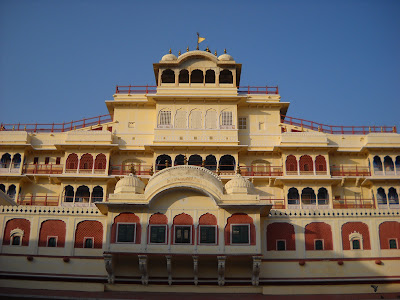
The City Palace of Jaipur is where the current King, Maharaja Sawai Bhawani Singh, still resides with his family. A part of the palace is open for the public to see and enjoy. Our guide, Digvijay, accompanies us through the palace and entertains us with trivia about the palace and the erstwhile kings. Our first stop is the Mubarak Mahal. Built by Maharaja Sawai Madho Singh II in 19th century to entertain his guests, today it has on display an array of robes, bedspreads, turbans and other textiles used by the kings and queens. A wedding robe, made of muslin from Dhaka and having 320 pleats, Maharaja Man Singh II’s winter as well as summer polo attire, Maharaja Sawai Madho Singh II’s (who was 7 feet tall, had a chest measuring 4 feet and weighed 250 kgs) robe and pyjama and many other clothes are on display.
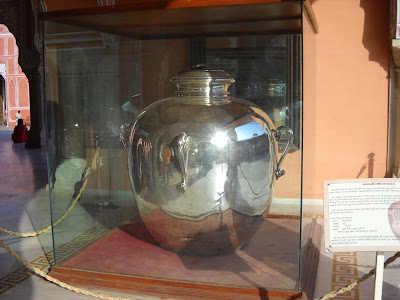
The Diwan – i – Khaas (Private meeting chamber of the King) has 2 large Silver Urns. These urns weigh 350 kgs each and can hold 900 galloons of water. Maharaja Sawai Madho Singh II would drink and use only water from the River Ganga to bathe. When he went to England on a visit, he carried water from the River Ganga in these two urns.
A little ahead was the Diwan – i – Aam (Public meeting chamber of the King). The grandeur of this room is a sight to be seen. Intricate leaf and flower patterns made using real gold, adorn the ceilings. A crystal chandelier hangs in the centre of the hall. This chandelier was brought from Czechoslovakia and can hold 108 candles. It is the 2nd largest chandelier in India. The erstwhile kings of Jaipur look at you from their places of the walls, as you walk around the hall.
An interesting fact that I learned here is that the modern game of Polo actually originated from India, in the 1800s. The British did popularize it, but they discovered the game in the North East Indian state of Manipur. In 1834, the world’s first polo club was established in Silchar, Assam in India.
Even before that, polo has been popular in India since the 12th century. During the Mughal period, the game (then called Chaughan) flourished. Even Emperor Akbar was fond of playing polo and introduced rules and regulations for the game.
JantarMantar
Yantar means instrument and Mantar means formula or calculation. But over time, the Y of yantar got converted to J, which is why it is now known as JantarMantar. The JantarMantar is located opposite the CityPalace in Jaipur.It is home to 14 devices which were commissioned by Maharaja Sawai Jai Singh II (the founder of Jaipur) in 1728. These devices were used to study astronomy by the scholars and the King, who was an avid astronomer himself. The JantarMantar in Jaipur is one of five built by Maharaja Sawai Jai Singh II in India (the others are in Mathura, New Delhi, Ujjain and Varanasi), but it is the only one that is still in working condition. No wonder then that it has been deemed a UNESCO World Heritage Site since 1st August 2010.
The gem in the JantarMantar’s crown is the 90 foot (27 m) tall Sun Dial (World’s largest) (also called Samrat Yantra) which tells you the time with an accuracy of 2 seconds. Jeetendra Singh, our guide, pointed out one important fact, “The Sun Dial can tell you the exact time at Jaipur. But since Indian standard time is derived from Allahabad, the time in Jaipur is 11 minutes behind IST.” We head to the Sun Dial and the shadow of the median shows that it is 4:20 pm in Jaipur. My watch says 4:31 pm. Point proved.
Other instruments like the Jaiprakash Yantra tell you what Sun Sign the Sun currently is in, while the Narivalaya Yantra lets you know whether the Sun is in the Northern or Southern Hemisphere, all based on where the Sun’s rays fall. Further down, are 13 constructions of stones (some in the form of stairs, triangles, etc.) facing a particular direction and set at a specific angle. When you look along the plain of the top end of the construction you can see the North Star or the star of the particular Sun Sign that the construction corresponds to. These contraptions can be tested only at night, but unfortunately the JantarMantar shuts its doors at 5 pm.
“The level of perfection that Maharaja Sawai Jai Singh II wanted in these instruments can be seen in the fact that each instrument was first made in the form of a rough model, then a miniature scaled model and finally the actual instrument was constructed” points out Jeetendra. He adds that all three models of each instrument are still present here.
All the instruments are made specifically for Jaipur’s location (Latitude of 27 degrees North), so if they were to be exactly replicated at any other place they would not work correctly.
I’m so glad I took some time out and visited the CityPalace and especially JantarMantar. It was an eye opener to see the level of knowledge that India had at that time. To have built something which, even after almost 300 years, works as well as any of the complicated new age machines, is nothing short of sheer genius.
Before we said our good byes, I had one last thing to ask Jeetendra. “Why is Jaipur called the Pink city? Is it because of a certain stone used in the buildings?” Laughing, he replied, “Nahi Sir, in 1853 the Prince of Wales was visiting India and the king at that time (Maharaja Sawai Ram Singh II) got the city painted pink, since pink was considered the color of hospitality. From that time on, the main road inside the walled city, where the Hawa Mahal stands, is pink in colour and Jaipur is known as the pink city.”
This makes me curious, why is Jodhpur called the ‘blue city’? Time to book a trip to Jodhpur to unravel that mystery.